Student AI Usage Progression by Grade Band
The use of AI (artificial intelligence) is scaffolded across K-12 education, shifting from foundational instruction to fully supervised observation to independent, responsible evaluation. The following table outlines a proposed breakdown of AI use by grade band.
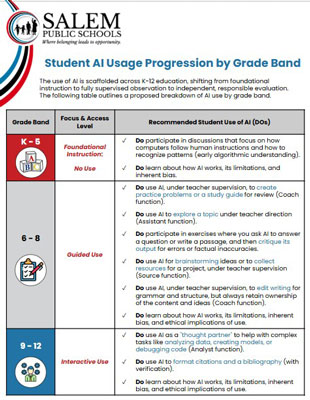
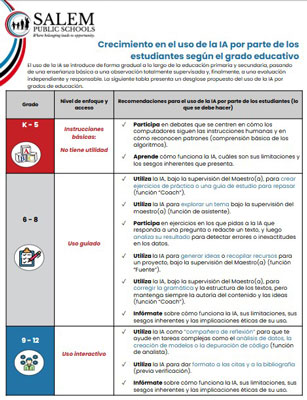
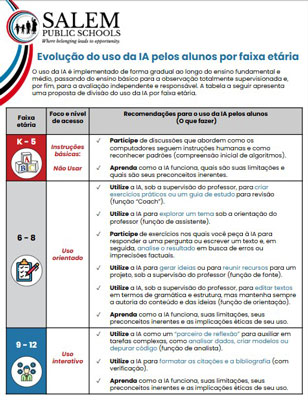
| Grade Band | Focus Access Level | Recommended Student Use of AI (DOs) |
| Grades K-5 | Foundational Instruction: No Use | DO participate in discussions that focus on how computers follow human instructions and how to recognize patterns (early algorithmic understanding). DO learn about how AI works, its limitations, and inherent bias. |
| Grades 6-8 | Guided Use | DO use AI, under teacher supervision, to create practice problems or a study guide for review (Coach function). DO use AI to explore a topic under teacher direction (Assistant function). DO participate in exercises where you ask AI to answer a question or write a passage, and then critique its output for errors or factual inaccuracies. DO use AI for brainstorming ideas or to collect resources for a project, under teacher supervision (Source function). DO use AI, under teacher supervision, to edit writing for grammar and structure, but always retain ownership of the content and ideas (Coach function). DO learn about how AI works, its limitations, inherent bias, and ethical implications of use. |
| Grades 9-12 | Interactive Use | DO use AI as a “thought partner” to help with complex tasks like analyzing data, creating models, or debugging code (Analyst function). DO use AI to format citations and a bibliography (with verification). DO learn about how AI works, its limitations, inherent bias, and ethical implications of use. |